

Aggregatibacter actinomycetemcomitans is a key pathogen in periodontal disease, damaging periodontal ligaments and alveolar bone through biofilm formation. D-LL-31, an engineered antimicrobial peptide, exhibits superior biofilm-killing ability compared to conventional treatments, while DNase I enhances its efficacy by disrupting the biofilm matrix. This study evaluated the combined effects of D-LL-31 and DNase I on A. actinomycetemcomitans biofilms. Results showed that D-LL-31 effectively eradicated biofilms, and its combination with DNase I further enhanced biofilm disruption without cytotoxicity to gingival epithelial cells. The D-LL-31 and DNase I combination shows potential for development as a mouthwash to improve oral health and combat periodontal disease.
โรคปริทันต์เป็นปัญหาสุขภาพช่องปากที่พบบ่อย โดยมี Aggregatibacter actinomycetemcomitans (Aa) เป็นหนึ่งในเชื้อก่อโรคสำคัญ เชื้อชนิดนี้สามารถสร้างไบโอฟิล์ม ซึ่งเป็นกลไกหลักที่ช่วยให้เชื้อดื้อยาต้านจุลชีพและหลบเลี่ยงระบบภูมิคุ้มกัน ทำให้การรักษาด้วยยาปฏิชีวนะทั่วไปไม่ได้ผลอย่างมีประสิทธิภาพ การพัฒนาแนวทางใหม่ในการกำจัดไบโอฟิล์มจึงเป็นสิ่งจำเป็น งานวิจัยนี้มุ่งเน้นศึกษาประสิทธิภาพของ D-LL-31 ซึ่งเป็นเปปไทด์ต้านจุลชีพที่ถูกแปลงทางวิศวกรรม เพื่อทำลายเชื้อที่อยู่ในไบโอฟิล์ม และการใช้ DNase I เพื่อสลายโครงสร้างเมทริกซ์ของไบโอฟิล์มร่วมกัน ซึ่งอาจเป็นแนวทางใหม่ในการพัฒนา น้ำยาบ้วนปาก ที่ช่วยลดเชื้อก่อโรคในช่องปากและป้องกันโรคปริทันต์ได้อย่างมีประสิทธิภาพ
คณะวิทยาศาสตร์
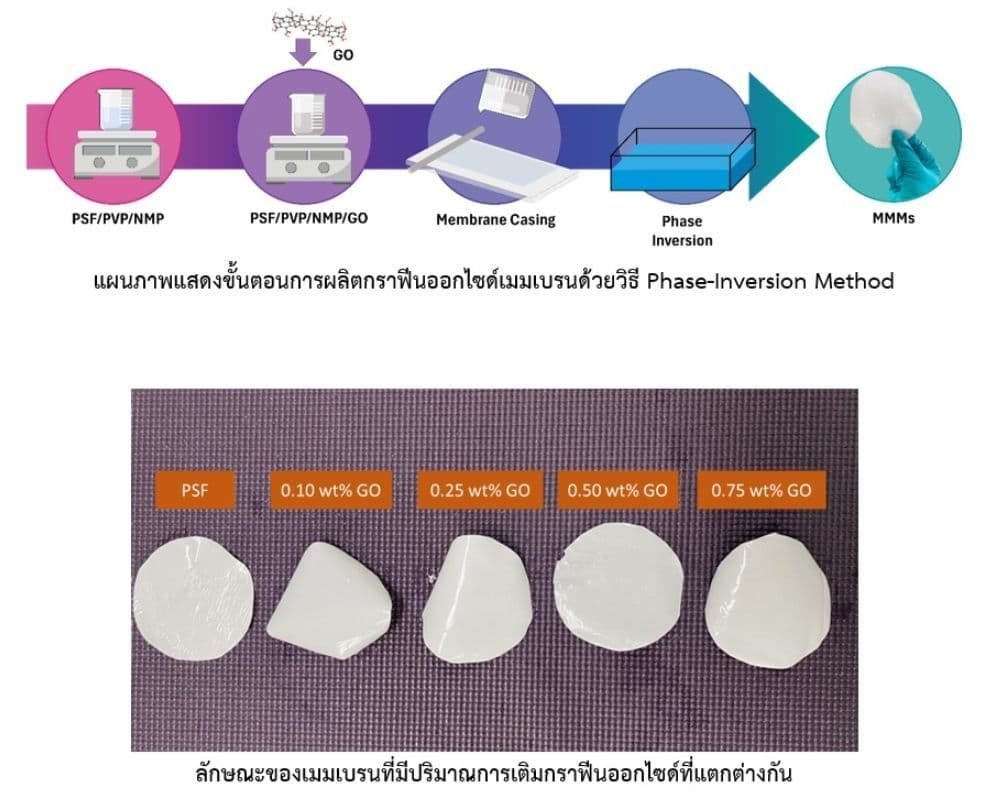
This research focuses on the fabrication of graphene oxide (GO) composite membranes using the Phase-Inversion Method, which transforms polymers from liquid to solid through phase separation. This process creates a porous membrane structure, making it highly adaptable, cost-effective, and suitable for wastewater treatment, separation processes, and industrial filtration applications. Graphene oxide, with its nano-layered structure, offers excellent molecular sieving properties, high water permeability, and chemical and mechanical stability, making it an ideal additive for membrane fabrication. The GO-based membrane demonstrates efficient removal of nanoparticles, heavy metal ions (Pb²⁺, Cr⁶⁺, Hg²⁺), organic pollutants, and microorganisms while exhibiting antifouling properties and high hydrophilicity due to oxygen-functional groups. Applications of this membrane include industrial wastewater treatment, desalination, and the removal of pharmaceutical contaminants, such as antibiotics and hormones. The incorporation of GO enhances membrane performance, providing a sustainable and energy-efficient solution for water purification.
วิทยาเขตชุมพรเขตรอุดมศักดิ์
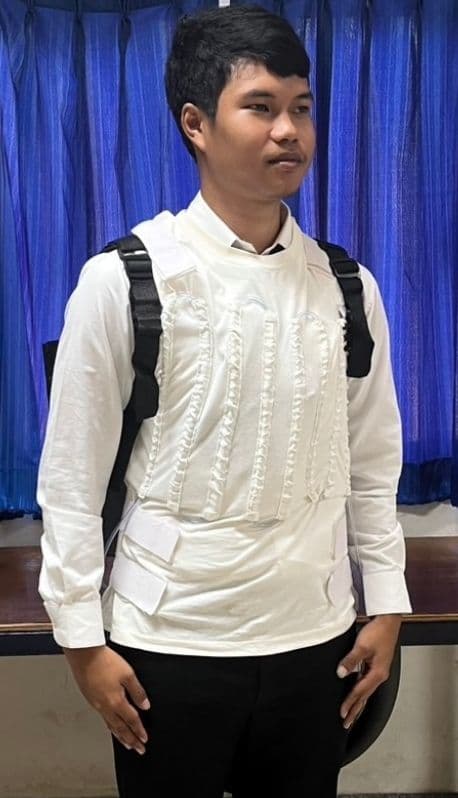
Cooling suit with two-phase flow heat-exchange system is a state-of-the-art heat sink, designed for thermal dissipation in fire fighter, racing driver and worker who needs to wear Personal Protective Equipment (PPE). The liquid cooling system with gas injection can enhance heat transfer performance and continuously maintain the temperature at 18-20 degree Celsius.

คณะเทคโนโลยีสารสนเทศ
This research presents a deep learning method for generating automatic captions from the segmentation of car part damage. It analyzes car images using a Unified Framework to accurately and quickly identify and describe the damage. The development is based on the research "GRiT: A Generative Region-to-text Transformer for Object Understanding," which has been adapted for car image analysis. The improvement aims to make the model generate precise descriptions for different areas of the car, from damaged parts to identifying various components. The researchers focuses on developing deep learning techniques for automatic caption generation and damage segmentation in car damage analysis. The aim is to enable precise identification and description of damages on vehicles, there by increasing speed and reducing the work load of experts in damage assessment. Traditionally, damage assessment relies solely on expert evaluations, which are costly and time-consuming. To address this issue, we propose utilizing data generation for training, automatic caption creation, and damage segmentation using an integrated framework. The researchers created a new dataset from CarDD, which is specifically designed for cardamage detection. This dataset includes labeled damages on vehicles, and the researchers have used it to feed into models for segmenting car parts and accurately labeling each part and damage category. Preliminary results from the model demonstrate its capability in automatic caption generation and damage segmentation for car damage analysis to be satisfactory. With these results, the model serves as an essential foundation for future development. This advancement aims not only to enhance performance in damage segmentation and caption generation but also to improve the model’s adaptability to a diversity of damages occurring on various surfaces and parts of vehicles. This will allow the system to be applied more broadly to different vehicle types and conditions of damage inthe future