

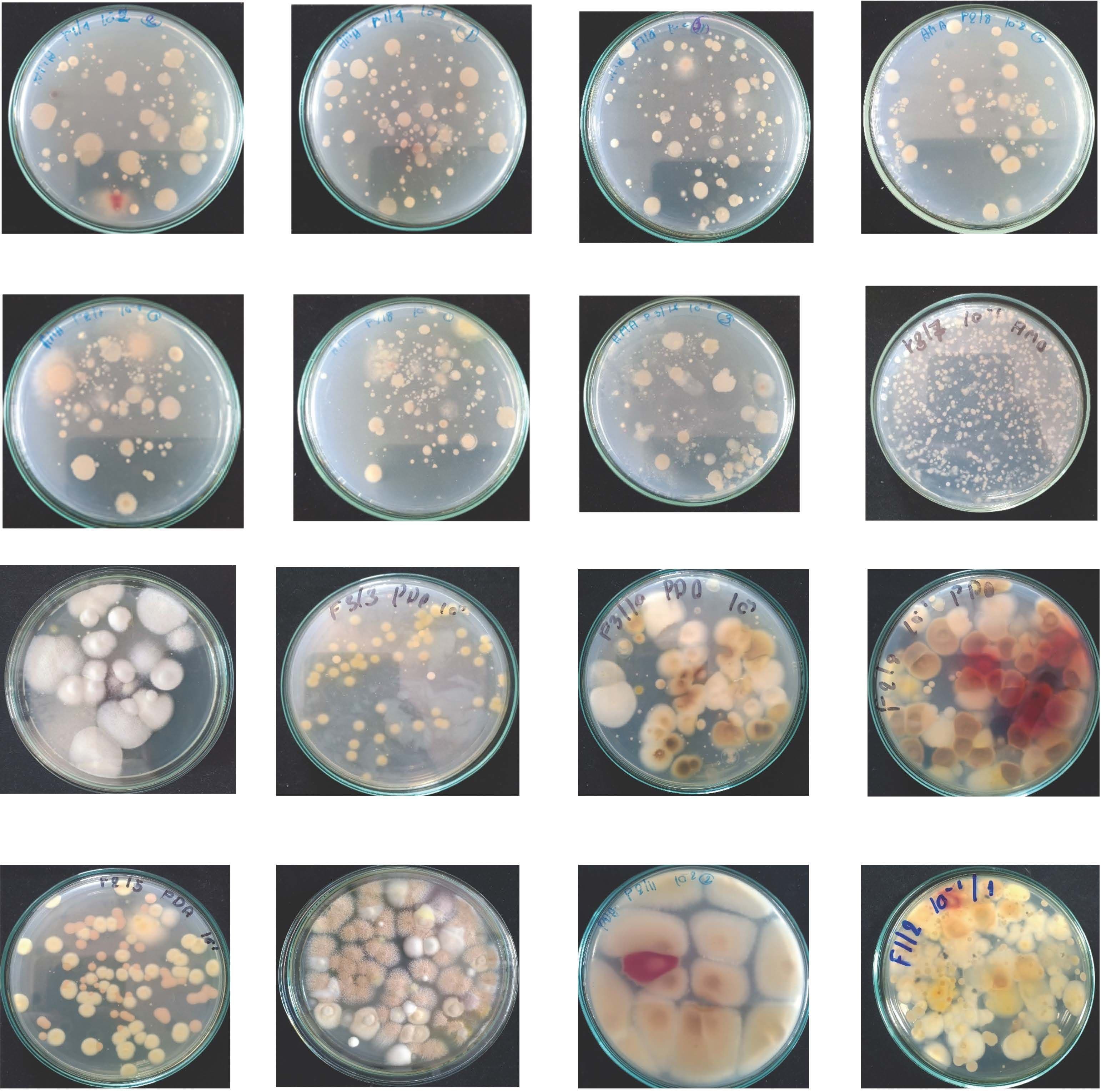
Soil is home to a diverse array of living organisms that interact within a complex food web, facilitating energy and nutrient cycling essential for sustaining life above ground. Among these organisms, soil microbes play a crucial role in supporting plant growth. Beneficial microorganisms enhance nutrient availability, improve soil structure by increasing porosity, and strengthen plant resistance to diseases. Conversely, harmful microorganisms, such as plant pathogens, can hinder plant growth and reduce crop yields when present in high concentrations. Neutral microorganisms, which naturally inhabit the soil, contribute to the soil ecosystem without directly impacting plants. A single teaspoon of soil contains over a billion microorganisms, yet only about 1% of them can be cultured in laboratory conditions. This highlights soil as one of the richest reservoirs of microbial diversity on Earth.
ในดินมีสิ่งมีชีวิตหลากหลายชนิดซึ่งมีความสัมพันธ์กันเป็นสายใยอาหารขนาดใหญ่ที่ทำให้เกิดการหมุนเวียนพลังงานและสารอาหารไปยังสิ่งมีชีวิตที่อาศัยอยู่บนดิน สิ่งมีชีวิตในดินทำหน้าที่สร้างอาหารสำหรับพืชเพื่อใช้ในการเจริญเติบโต ดินมีลักษณะเป็นรูพรุน มีทั้งน้ำ อากาศ ธาตุอาหารต่างๆ จึงเป็นแหล่งที่อยู่อาศัยของสิ่งมีชีวิตหลากหลายชนิด ซึ่งสิ่งมีชีวิตแต่ละชนิดจะมีบทบาทหลากหลายแตกต่างกันไป กลุ่มสิ่งมีชีวิตที่พบในดินได้แก่

คณะวิทยาศาสตร์
Otitis Media is an infection of the middle ear that can occur in individuals of all ages. Diagnosis typically involves analyzing images taken with an otoscope by specialized physicians, which relies heavily on medical experience to expedite the process. This research introduces computer vision technology to assist in the preliminary diagnosis, aiding expert decision-making. By utilizing deep learning techniques and convolutional neural networks, specifically the YOLOv8 and Inception v3 architectures, the study aims to classify the disease and its five characteristics used by physicians: color, transparency, fluid, retraction, and perforation. Additionally, image segmentation and classification methods were employed to analyze and predict the types of Otitis Media, which are categorized into four types: Otitis Media with Effusion, Acute Otitis Media with Effusion, Perforation, and Normal. Experimental results indicate that the classification model performs moderately well in directly classifying Otitis Media, with an accuracy of 65.7%, a recall of 65.7%, and a precision of 67.6%. Moreover, the model provides the best results for classifying the perforation characteristic, with an accuracy of 91.8%, a recall of 91.8%, and a precision of 92.1%. In contrast, the classification model that incorporates image segmentation techniques achieved the best overall performance, with an mAP50-95 of 79.63%, a recall of 100%, and a precision of 99.8%. However, this model has not yet been tested for classifying the different types of Otitis Media.
คณะบริหารธุรกิจ
This project aims to develop seafood dipping sauce and Jaew sauce in solid cube form to address the limitations of liquid sauces, which can be difficult to carry and prone to spillage, as well as powdered sauces, which may lose their texture and authentic flavor. The research and development process focuses on utilizing distinct ingredients and innovative production techniques to enhance the quality and functionality of the product. The primary objective of this project is to introduce an innovative solution that improves the convenience of consumption and transportation while preserving the original taste and quality of traditional dipping sauces. The expected outcome is a novel dipping sauce product in solid cube form that is easy to carry, minimizes the risk of spillage, and holds potential for commercial development in the food industry.
คณะวิทยาศาสตร์
-