
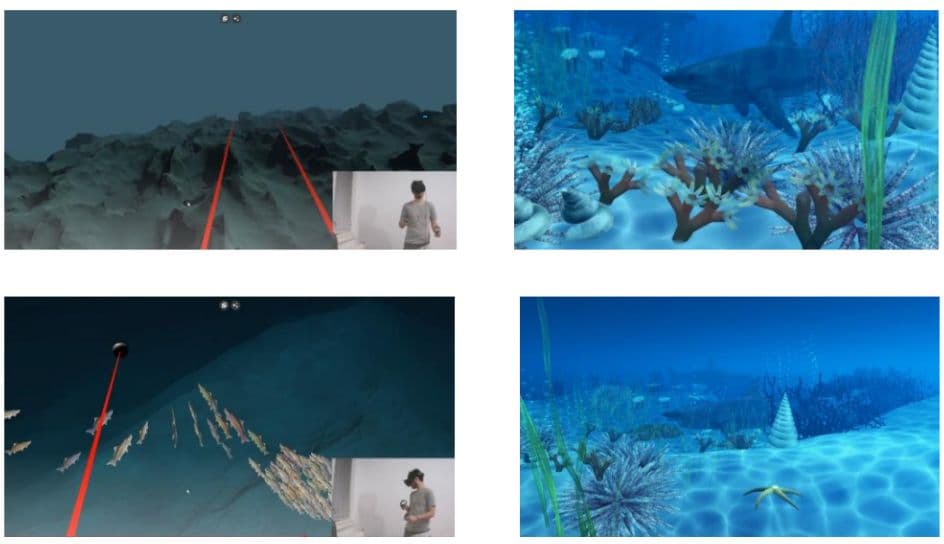
This research aims to design and develop a prototype Virtual Reality Based Underwater Thai Marine Fishes Museum using computer animation and VR technology to simulate Thailand's marine ecosystems across both the Gulf of Thailand and the Andaman Sea. The museum is divided into three zones covering brackish water, coastal, and deep-sea environments, allowing visitors to experience an immersive and interactive underwater world through a VR application. The project promotes marine ecology education and supports the conservation of Thailand's aquatic biodiversity in a sustainable and engaging manner.
ปัจจุบันเทคโนโลยีความจริงเสมือน (Virtual Reality) ได้กลายเป็นเครื่องมือสำคัญในการศึกษาสัณฐานวิทยาของปลาและระบบนิเวศทางทะเล ช่วยสร้างประสบการณ์แบบดื่มด่ำและโต้ตอบได้ที่ตัวอย่างทางกายภาพไม่สามารถทดแทนได้ พิพิธภัณฑ์ปลาแบบดั้งเดิมมักใช้ตัวอย่างที่แช่สารเคมีซึ่งสีและรูปลักษณ์ไม่น่าสนใจ โดยเฉพาะสำหรับเด็กและเยาวชน การนำ VR มาพัฒนาพิพิธภัณฑ์จึงเปิดมิติใหม่ในการศึกษาชนิดและระบบนิเวศของปลาทะเลไทยทั้งฝั่งอ่าวไทยและอันดามัน ซึ่งจะช่วยกระตุ้นความสนใจในการเรียนรู้วิทยาศาสตร์ทางทะเลและสนับสนุนการอนุรักษ์ระบบนิเวศทางทะเลของประเทศได้อย่างมีประสิทธิภาพ

คณะวิทยาศาสตร์
This project aims to investigate and develop an energy storage system utilizing solar energy sources through the integration of solar cell technology and Graphene Quantum Dot Battery, representing a novel approach to enhancing energy storage efficiency and prolonging the lifespan of renewable energy systems. The selection of graphene and quantum dots as materials for battery development is attributed to their exceptional properties, including high electrical conductivity, charge storage capacity, efficient energy transfer, and enhanced stability.

วิทยาลัยการจัดการนวัตกรรมและอุตสาหกรรม
The Water Hyacinth Removal Electric Smart Boat is a small, streamlined boat capable of working in any area. Even small areas with a lot of water hyacinth volumes with advanced technology that the researcher has created and designed. The structure of the boat is made of aluminum material, is 4.80 meters long and 1.20 meters wide, and is powered by a diesel engine 14 hp. Reinforcing drive in tandem with spinning, chopping weeds and the ability to remove water hyacinths by spinning 3-5 per day with only one operator on boat. Therefore, the control and removal of water hyacinths by smart boat works better than conventional mechanization. It can work quickly and at a low cost. This water hyacinth removal electric smart boat concept will be built on the original system.

วิทยาลัยอุตสาหกรรมการบินนานาชาติ
The capture of a target spacecraft by a chaser is an on-orbit docking operation that requires an accurate, reliable, and robust object recognition algorithm. Vision-based guided spacecraft relative motion during close-proximity maneuvers has been consecutively applied using dynamic modeling as a spacecraft on-orbit service system. This research constructs a vision-based pose estimation model that performs image processing via a deep convolutional neural network. The pose estimation model was constructed by repurposing a modified pretrained GoogLeNet model with the available Unreal Engine 4 rendered dataset of the Soyuz spacecraft. In the implementation, the convolutional neural network learns from the data samples to create correlations between the images and the spacecraft’s six degrees-of-freedom parameters. The experiment has compared an exponential-based loss function and a weighted Euclidean-based loss function. Using the weighted Euclidean-based loss function, the implemented pose estimation model achieved moderately high performance with a position accuracy of 92.53 percent and an error of 1.2 m. The in-attitude prediction accuracy can reach 87.93 percent, and the errors in the three Euler angles do not exceed 7.6 degrees. This research can contribute to spacecraft detection and tracking problems. Although the finished vision-based model is specific to the environment of synthetic dataset, the model could be trained further to address actual docking operations in the future.