

KMITL Expo 2026 LogoKMITL 66th Anniversary Logo

High Performance Oil Trap Bouy from Natural Nanofiber

High Performance Oil Trap Bouy from Natural Nanofiber

Abstract

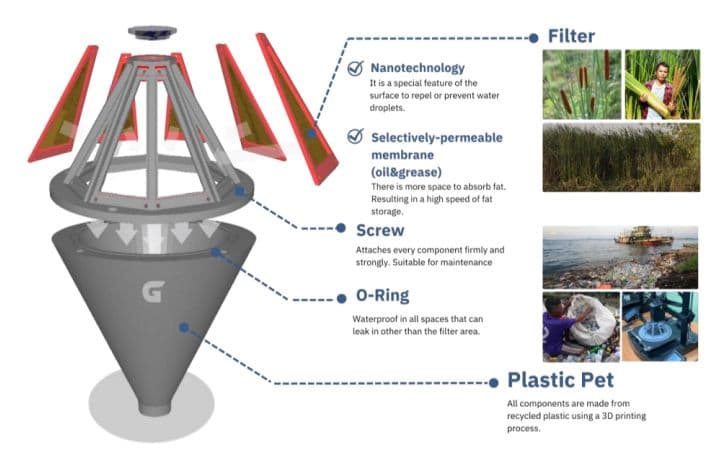
Oil and grease pollution is an urgent environmental problem severely affecting aquatic ecosystems and mangrove forests, particularly in the Mani Rat Canal area, Samut Sakhon Province, where no effective solution currently exists. This research aims to develop a "high-efficiency oil-trapping buoy using superhydrophobic membrane technology" by synthesizing cattail flowers into Carbon Nanofiber material for capturing oil and grease, combined with waste PET plastic collected from mangrove areas as the primary structural material. This approach not only addresses water pollution but also enables the recovered oil to be further processed and utilized, representing an environmentally friendly solution that promotes sustainable resource management.

Objective

ปัจจุบันโลกกำลังเผชิญกับปัญหาสิ่งแวดล้อมที่ส่งผลให้สิ่งมีชีวิตบนโลกลดจำนวนลงอย่างต่อเนื่อง หนึ่งในสาเหตุหลักคือมลพิษทางน้ำ โดยเฉพาะมลพิษจากน้ำมันและคราบไขมัน จากข้อมูลของ The United States Geological Survey (USGS) พบว่าในแต่ละปีมีน้ำมันรั่วไหลลงสู่แหล่งน้ำทั่วโลกถึง 14 ล้านตัน นอกจากนี้ในประเทศไทยยังมีอัตราการปล่อย FOG (fat, oil, and grease) จากครัวเรือนสูงถึง 30,000 ตันต่อวัน ยังไม่รวมถึง FOG จากโรงงานอุตสาหกรรมและการลักลอบทิ้งลงแม่น้ำลำคลอง มลพิษดังกล่าวส่งผลให้น้ำเน่าเสีย แสงแดดส่องผ่านลงสู่ผิวน้ำได้น้อยลง และการแลกเปลี่ยนออกซิเจนในน้ำลดลง ทำให้พืชใต้น้ำไม่สามารถดูดซับสารอาหาร รับแสง และออกซิเจนได้ตามปกติ ส่งผลให้สิ่งมีชีวิตใต้น้ำขาดออกซิเจน ดังเช่นกรณีปลาเก๋าในกระชังของชาวประมงในอ่าวบ้านแหลมกรวด จังหวัดกระบี่ ที่ตายเนื่องจากขาดออกซิเจนอันเป็นผลจากน้ำมันเตารั่วไหลลงทะเลกว่า 10,000 ลิตร ทีมวิจัยได้ลงพื้นที่ศึกษาปัญหาร่วมกับเจ้าหน้าที่ศูนย์วิจัยทรัพยากรป่าชายเลนที่ 2 จังหวัดสมุทรสาคร และพบว่ามลพิษจากน้ำมันและคราบไขมันในป่าชายเลนบริเวณคลองมณีรัตน์ จังหวัดสมุทรสาคร เป็นปัญหาเร่งด่วนที่ยังไม่มีวิธีการแก้ไขที่มีประสิทธิภาพในปัจจุบัน โดยสาเหตุหลักมาจากน้ำมันและไขมันจากชุมชนและโรงงานอุตสาหกรรม รวมถึงน้ำมันจากเรือประมงที่ไหลลงสู่ทะเลและสะสมอยู่บริเวณป่าชายเลน จากการศึกษาปัญหาดังกล่าว ทีมวิจัยจึงได้ออกแบบและพัฒนา "ทุ่นดักจับคราบน้ำมันประสิทธิภาพสูงด้วยเทคโนโลยีซูเปอร์ไฮโดรโฟบิกเมมเบรน" โดยนำดอกธูปฤาษีซึ่งเป็นวัสดุชีวมวลมาสังเคราะห์เป็นวัสดุเส้นใยนาโนคาร์บอน (Carbon Nanofiber) เพื่อทำหน้าที่ดักจับน้ำมันและคราบไขมันเก็บไว้ภายในทุ่น และสามารถนำน้ำมันที่ดักจับได้ไปแปรรูปใช้ประโยชน์ต่อได้ แทนที่จะปล่อยให้เป็นของเสียทำลายระบบนิเวศป่าชายเลน ทั้งนี้วัสดุที่ใช้ในการผลิตทุ่น ได้แก่ พลาสติก PET ที่เป็นขยะในป่าชายเลน และดอกธูปฤาษีซึ่งเป็นวัชพืชที่พบได้ทั่วไปในพื้นที่ป่าชายเลน
Other Innovations

Development of Innovative Banana Blossom Powder Production for Application in Functional Snack Products

คณะอุตสาหกรรมอาหาร

Development of Innovative Banana Blossom Powder Production for Application in Functional Snack Products

Thailand produces over 1.2 million tons of bananas annually, generating substantial agricultural waste — particularly banana blossoms, which are highly nutritious, rich in dietary fiber and antioxidants, yet are commonly discarded. This study aimed to develop a "fiber-enriched baked snack using banana blossom powder" to add value to this underutilized raw material and meet the growing demand of health-conscious consumers. The prototype product received second runner-up recognition at the Conovative Award 2024. However, limitations were identified in terms of coarse texture, dark coloration, and residual astringency. This research therefore focuses on optimizing the pretreatment process through safe physical and chemical methods, alongside a comparative evaluation of drying techniques — including hot-air drying, freeze drying, and microwave drying — to maximize the retention of nutritional value and bioactive compounds. The findings are expected to enhance the applicability of banana blossom powder in health food products, particularly snacks requiring refined physical and sensory qualities, and to support further commercial development.

Read more
Bacteriocinogenomic analysis and anti-pathogenic activity of potential Lactococcus lactis TKP1-5 isolated from the feces of Anas platyrhynchos

คณะวิทยาศาสตร์

Bacteriocinogenomic analysis and anti-pathogenic activity of potential Lactococcus lactis TKP1-5 isolated from the feces of Anas platyrhynchos

Bacteriocins are microbial peptides that demonstrate potency against pathogens. This study evaluated the inhibitory effects on pathogens and characterized the bacteriogenomic profile of strain TKP1-5, isolated from the feces of Anas platyrhynchos domesticus. Strain TKP1-5 was characterized using phenotypic traits, 16S rRNA sequencing, and Whole-Genome Sequencing (WGS). It exhibited growth in the presence of 2-6% NaCl, temperatures of 25-45°C, and pH levels ranging from 3 to 9. Based on ANIb, ANIm, and dDDH values, strain TKP1-5 was identified as Lactococcus lactis. Whole genome analysis revealed that strain TKP1-5 harbors the Nisin Z peptide gene cluster with a bit-score of 114.775. The antimicrobial spectrum of bacteriocin TKP1-5 showed inhibitory effects against pathogenic bacteria including Pediococcus pentosaceus JCM5885, Listeria monocytogenes ATCC 19115, Enterococcus faecalis JCM 5803T, Salmonella Typhimurium ATCC 13311ᵀ, Aeromonas hydrophila B1 AhB1, Streptococcus agalactiae 1611 and Streptococcus cowan I. Genomic analysis confirmed L. lactis TKP1-5 as a non-human pathogen without antibiotic resistance genes or plasmids. Furthermore, L. lactis TKP1-5 contains potential genes associated with various probiotic properties and health benefits. This suggests that L. lactis TKP1-5, with its antibacterial activity and probiotic potential, could be a promising candidate for further research and application in the food industry.

Read more
Efficacy of mangosteen (Garcinia mangostana) peel hot water extract against Aeromonas hydrophila infection of seabass fingerling (Lates calcarifer)

คณะเทคโนโลยีการเกษตร

Efficacy of mangosteen (Garcinia mangostana) peel hot water extract against Aeromonas hydrophila infection of seabass fingerling (Lates calcarifer)

Mangosteen peel (Garcinia mangostana Linn.) extract using hot water (MPE) has been shown to have antibacterial potential in freshwater sea bass (Lates calcarifer) larvae infected with Aeromonas hydrophila. In vitro studies showed that MPE has a minimum inhibitory concentration (MIC) of 25 ppm and a minimum bactericidal concentration (MBC) of 25 ppm. In vivo, sea bass larvae were immersed in various concentrations of MPE at 0 ppm (control), 20 ppm, 40 ppm and 60 ppm, respectively, for 7 days with A. hydrophila. The results showed that the MPE-treated group had a higher survival rate compared to the control group. Hematological parameters showed that the MPE-treated group had significantly increased red blood cell (RBC), white blood cell (WBC) and hemoglobin (Hb) concentrations compared to the control group. In addition, the water quality parameters were not significantly different, except for ammonia concentration, with MPE having an ammonia concentration of 60 ppm being the lowest. All results can indicate that MPE can improve the antibacterial potential and the culture potential of sea bass larvae.

Read more