
KMITL Expo 2026 LogoKMITL 66th Anniversary Logo

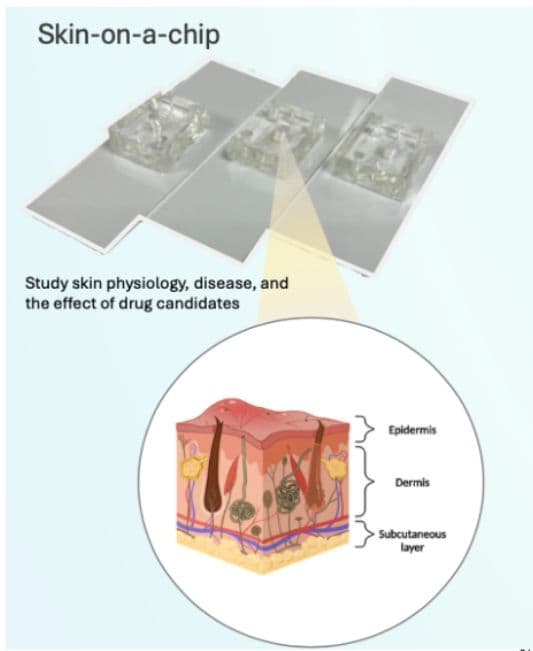
Development and Testing of Skin-on-a-Chip Device for Pharmaceutical and Cosmeceutical Applications

Development and Testing of Skin-on-a-Chip Device for Pharmaceutical and Cosmeceutical Applications

Abstract

This research aims to develop and test a Skin-on-a-Chip (SoC) device that integrates skin cells and endothelial cells within a microfluidic system to closely simulate the biological environment of human skin. The device reduces reliance on animal testing while lowering research costs and time, and improves the accuracy of pharmaceutical and cosmeceutical ingredient testing. The project targets TRL 5 prototype development alongside patent filing and pilot-scale manufacturing process development, with a clear pathway toward commercial readiness within two years.

Objective

อุตสาหกรรมเภสัชกรรมและเครื่องสำอางในปัจจุบันเผชิญกับความท้าทายด้านการพัฒนาผลิตภัณฑ์ที่ใช้เวลาและทรัพยากรสูง โดยข้อมูลจากการทดลองในสัตว์หรือการเพาะเลี้ยงเซลล์แบบสองมิติมักไม่สะท้อนการตอบสนองของร่างกายมนุษย์อย่างแท้จริง เทคโนโลยีอวัยวะบนชิป (Organ-on-a-Chip) จึงถูกพัฒนาขึ้นเพื่อจำลองสภาวะเนื้อเยื่อมนุษย์ในระดับไมโคร ช่วยลดการพึ่งพาการทดลองในสัตว์และเพิ่มความแม่นยำในการทดสอบ ประเทศไทยยังอยู่ในช่วงเริ่มต้นของการพัฒนาเทคโนโลยีนี้ โครงการจึงมีความสำคัญทั้งในมิติการพัฒนาองค์ความรู้ การสร้างนวัตกรรม และการเสริมสร้างความสามารถในการแข่งขันของอุตสาหกรรมการแพทย์และเครื่องสำอางของไทยอย่างยั่งยืน

Other Innovations

Automated Hydroponic System for Home Use

คณะวิศวกรรมศาสตร์

Automated Hydroponic System for Home Use

An automated hydroponic system for household use has been developed to cater to individuals with limited space who wish to conveniently and easily grow their own salad greens at home. This system is designed to automatically control nutrient delivery by setting appropriate electrical conductivity (EC) and pH levels tailored to the specific salad greens being grown. It includes artificial lighting to enable cultivation in confined spaces with insufficient sunlight and is more cost-effective than similar systems available on the market. System testing revealed that the automated control of EC and pH values performed effectively, achieving the preset levels within 30 minutes and maintaining them consistently throughout operation. In an experiment growing green oak lettuce using a simulated balcony setup, the plants demonstrated a higher growth rate compared to conventional methods, particularly when artificial lighting was used.

Read more
Application of Machine Learning, Stochastic Process, and Game Theory in Short-Term Financial Asset Investment Strategies

คณะวิทยาศาสตร์

Application of Machine Learning, Stochastic Process, and Game Theory in Short-Term Financial Asset Investment Strategies

This project focuses on the study and development of a short-term investment framework via gold trading in the foreign exchange market. Machine learning techniques are applied to analyze and forecast pricing trends. Moreover, we develop the system using a stochastic process to determine optimal stop-loss points, with the aim of maximizing expected returns. Additionally, we apply game theory to guide the decision-making process regarding order holding or closure. The system is implemented and tested on the MetaTrader 5 (MT5) platform. This project outlined the clear process that includes data preparation, machine learning model training, probabilistic modeling of gold price movements, stop-loss strategy formulation, strategic decision modeling based on game theory, the development of an automated trading program, and backtesting to evaluate system performance.

Read more
Viola edible flower production in soilless culture

คณะเทคโนโลยีการเกษตร

Viola edible flower production in soilless culture

The objective of this experiment was to determine the effect of nitrogen and potassium concentration combination with photoperiod on the growth of Viola in a plant factory to increase the quality of the products, reduce the production time and increase the production cycle throughout the year. The experimental plan was 3x3 Factorial in CRD with nine treatments and three replications (six plants per replication). The factor of this study was two factors; the first factor was three different concentrations of nitrogen and potassium in ratios of 1:1, 1:2 and 2:1. The second factor was the application of different photoperiods. There were 1) 24-hours photoperiod, 2) 8-hours light/16-hours dark photoperiod (Induced flowering state: 13-hours light/11-hours dark photoperiod) and 3) 5-hours light/3-hours dark photoperiod. Controlled temperature at 25 °C, the EC=1.5-2.0 mS/cm and the pH=5.8-6.5 in all treatment. The result showed that the concentration of N: K in the ratio of 1:1 combined with 24-hour photoperiod was the most vegetative growth and also maximizes reproductive growth. The overall great sensory evaluation was an acceptable level and suitable for cooking or decorating dishes. Therefore, the concentration of N: K in the ratio of 1:1 combined with 24-hour photoperiod is the best treatment to increase the quality of the product, reduce the production time of viola flowers in each cycle from 90-100 days down to 43-45 days which is good for farmers.

Read more