

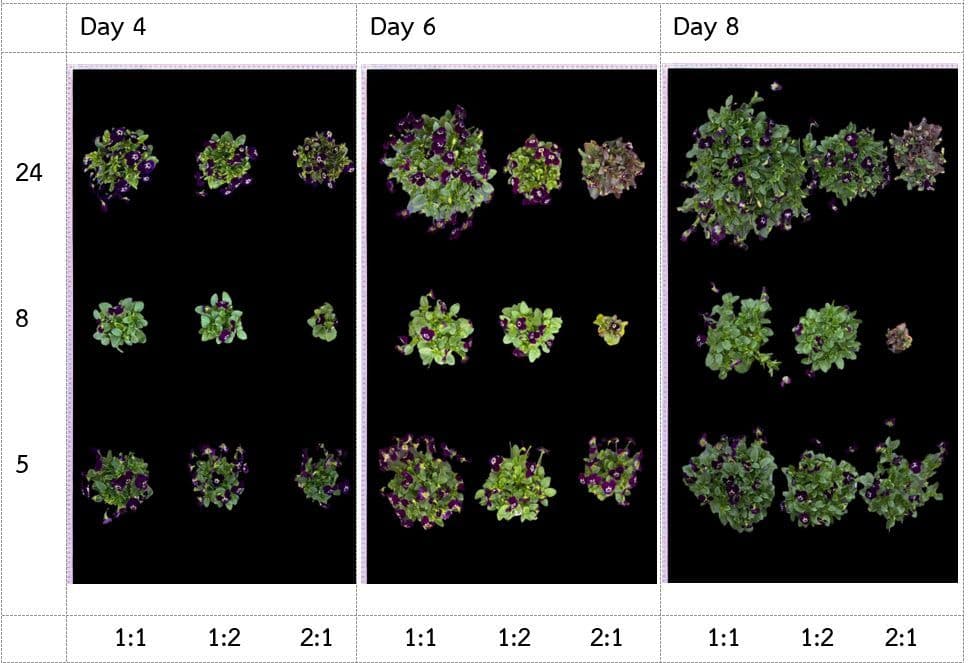
The objective of this experiment was to determine the effect of nitrogen and potassium concentration combination with photoperiod on the growth of Viola in a plant factory to increase the quality of the products, reduce the production time and increase the production cycle throughout the year. The experimental plan was 3x3 Factorial in CRD with nine treatments and three replications (six plants per replication). The factor of this study was two factors; the first factor was three different concentrations of nitrogen and potassium in ratios of 1:1, 1:2 and 2:1. The second factor was the application of different photoperiods. There were 1) 24-hours photoperiod, 2) 8-hours light/16-hours dark photoperiod (Induced flowering state: 13-hours light/11-hours dark photoperiod) and 3) 5-hours light/3-hours dark photoperiod. Controlled temperature at 25 °C, the EC=1.5-2.0 mS/cm and the pH=5.8-6.5 in all treatment. The result showed that the concentration of N: K in the ratio of 1:1 combined with 24-hour photoperiod was the most vegetative growth and also maximizes reproductive growth. The overall great sensory evaluation was an acceptable level and suitable for cooking or decorating dishes. Therefore, the concentration of N: K in the ratio of 1:1 combined with 24-hour photoperiod is the best treatment to increase the quality of the product, reduce the production time of viola flowers in each cycle from 90-100 days down to 43-45 days which is good for farmers.
ปัจจุบันการบริโภคดอกไม้กินได้ เป็นอีกทางเลือกหนึ่งที่ผู้บริโภคให้ความสนใจ ซึ่งดอกไม้แต่ละชนิดมีคุณค่าทางอาหารและสารต้านอนุมูลอิสระที่แตกต่างกันไป (สุพัตรา, 2548) โดยดอกไม้แต่ละชนิดจะมีสารสำคัญแตกต่างกันขึ้นอยู่กับสีของกลีบดอกไม้ เช่น สารในกลุ่มโพลีฟีนอล ฟลาโวนอยด์ และสารกลุ่ม anthocyanins มักพบในดอก เจอราเนียม กุหลาบ เบญจมาศ ชบา พิทูเนีย แพนซี และวิโอลา (Kumari, 2017) ซึ่งสารสำคัญเหล่านี้มีคุณสมบัติในการต้านอนุมูลอิสระป้องกันการเกิดโรคอัลไซเมอร์ โรคหลอดเลือดหัวใจ และยังเป็นสารต้านมะเร็ง รวมถึงช่วยชะลอความชรา (Shi et al., 2008; Kaisoon et al., 2011) ดอกไม้กินได้ที่นิยมใช้ประกอบอาหารหรือตกแต่งจาน ได้แก่ เดซี่ แนสเตอร์ชัม คาโมมายล์ ผีเสื้อ และวิโอลา (Face food accessory, 2564) ดอกวิโอลา มีกลิ่นหอมอ่อนและรสเปรี้ยว อุดมไปด้วยวิตามินเอ อีและซี ส่วนใหญ่นิยมนำไปประกอบในเมนูสลัด (มูลนิธิโครงการหลวง, 2561; ออนไลน์) โดยต้นวิโอลา (Viola) อยู่ในวงศ์ Violaceae มีอยู่ 25 สกุล ประมาณ 525 -600 ชนิด กระจายพันธุ์อยู่ทั่วโลก (William, 2020) มีถิ่นกำเนิดในประเทศที่มีอากาศอบอุ่นจนถึงอากาศหนาวเย็น เป็นไม้ล้มลุก อายุสั้น ต้นสูง 10-30 เซนติเมตร ใบเป็นใบเดี่ยว ออกเรียงสลับ ขอบใบหยักเป็นฟันเลื่อย กลีบดอกกลมกว้าง มี 5 กลีบเกยซ้อนกัน สีของกลีบดอกมีด้วยกันหลายสี เช่น สีขาว สีส้ม สีชมพู สีม่วงเข้มและสีเหลือง เป็นต้น (นายเกษตร, 2554; ออนไลน์) ธาตุอาหารมีความสําคัญต่อการดํารงชีวิตของพืช ส่งผลต่อคุณภาพผลผลิต หากขาดหรือไม่มีเลยจะทําให้พืชแสดงอาการผิดปกติ หรือตายได้ ดังนั้นการให้ธาตุอาหารในระดับที่เหมาะสมและสมดุลจึงมีความเฉพาะเจาะจงกับพืชแต่ละชนิดแตกต่างกัน โดยธาตุไนโตรเจนและโพแทสเซียม เป็นธาตุอาหารหลักที่จําเป็นสําหรับการเจริญเติบโตและให้ผลผลิตของพืช ช่วยในการกระตุ้นเอนไซม์ที่ใช้ในการสังเคราะห์แสงและการหายใจ ซึ่งจะช่วยส่งเสริมการเคลื่อนย้ายแป้ง น้ำตาล และโปรตีนจากใบไปสู่ผล ช่วยส่งเสริมการเจริญเติบโตของราก ทําให้รากดูดน้ำ ดูดธาตุอาหาร ได้ดีขึ้น เร่งการออกดอก และทําให้พืชมีสีสันเพิ่มมากขึ้น (ไทยเกษตรศาสตร์, 2555; ออนไลน์) จากการศึกษาความเข้มข้นของธาตุไนโตรเจนและโพแทสเซียมต่อการเจริญเติบโตของแพงพวยเลื้อย พบว่า ระดับของไนโตรเจนที่ 100 มิลลิกรัมต่อลิตร ให้ขนาดทรงพุ่มกว้างที่สุด แต่ความเข้มข้นที่ 200 มิลลิกรัมต่อลิตร ให้จํานวนดอกต่อต้นมากที่สุด (ประภาพรรณ, 2556) นอกจากนี้แสงยังเป็นปัจจัยทางสภาพแวดล้อมที่เกี่ยวข้องกับการออกดอกของพืชโดยตรง ซึ่งเป็นแหล่งพลังงานที่สำคัญ ในการสร้างอาหารและการสะสมอาหารในพืช (สมบุญ, 2538) โดยเฉพาะความยาววัน (photoperiod) จากการศึกษาในฟรีเซีย พบว่า สภาพวันสั้นมีผลต่อการกระตุ้นการเกิดและการพัฒนาตาดอกของฟรีเซียในช่วงแรก และความเข้ม แสงต่ำชะลอการสร้างตาดอก (flower initiation) และการพัฒนาตาดอก (flower development) (โสระยา, 2543) ดอกไม้กินได้ปลูกทั้งในดินและปลูกโดยไม่ใช้ดิน แต่การปลูกวิโอลาในสภาพธรรมชาติมักพบปัญหาการแสดงอาการขาดธาตุอาหาร เนื่องจากมีการให้ปุ๋ยในอัตราส่วนที่ไม่เหมาะสมส่งผลให้พืชได้รับธาตุอาหารที่ไม่สมดุลกัน ทำให้พืชแสดงอาการขาดธาตุอาหาร หยุดการเจริญเติบโต อีกทั้งการควบคุมปัจจัยที่ส่งผลต่อการเจริญเติบโตของพืชก็เป็นไปได้ยาก เกิดโรคและแมลงศัตรูพืชเข้าทำลาย ปัญหาเหล่านี้จะส่งผลให้คุณภาพและปริมาณของผลผลิตลดลง ปัญหาเรื่องธาตุอาหาร น้ำ แสง โรคและแมลง จะสามารถควบคุมได้ เมื่อปลูกพืชในระบบ Plant Factory ซึ่งเป็นเทคโนโลยีการปลูกพืชที่พัฒนามาจากการปลูกพืชในระบบไฮโดรโปนิกส์ ร่วมกับการควบคุมปัจจัยภายนอก ได้แก่ ความเข้มแสง อุณหภูมิ ปริมาณก๊าซคาร์บอนไดออกไซด์ การจัดการโรคและแมลง และด้วยความสามารถในการควบคุมปัจจัยในการผลิตได้ (วรพจน์, 2557; Kozai et al., 2016) จึงสามารถกำหนดรอบหรือระยะเวลาการผลิตพืชได้ เช่น ให้แสงเพื่อกระตุ้นการออกดอก เร่งวันในการออกดอกของวิโอลา ผลผลิตแต่ละรอบจะออกดอกเร็วขึ้น มีคุณภาพดี สะอาด ปราศจากโรค และผลิตพืชได้ตลอดทั้งปี ดังนั้นการวิจัยครั้งนี้จึงมุ่งเน้นศึกษาระดับความเข้มข้นของธาตุไนโตรเจนและโพแทสเซียมร่วมกับจำนวนชั่วโมงในการให้แสงต่อการเจริญเติบโตของต้นวิโอลาในระบบ Plant Factory
คณะเทคโนโลยีการเกษตร
-
คณะวิศวกรรมศาสตร์
-

คณะวิศวกรรมศาสตร์
During the recent years, PM2.5 concentration is rising above the safety exposure limit in Thailand. PM2.5 could have originated from various sources such as exhaust fumes, open air burning, wildfire, etc. This concludes that all cities or places would have different PM source contributions. Most studies regarding the PM source findings were done based on chemical analysis. Our research team would like to predict the PM sources physically by nanostructures analysis. These methods would require the PM dust to be collected in a limited amount of time and dry. The use of paper filters may cause contamination from filter material which may cause errors in result evaluation. Our team suggests using Electrostatic Precipitator (ESP) where electrostatics is used to capture PM dust. This research mainly focuses on designing and building the ESP system for PM collection whereas the requirement is to collect at least 100 mg of PM dust within 1 day which would be adequate for nanostructure analysis. The study revealed that the customized ESP system could achieve of up to 80% collecting efficiency (which is more than the commercial ESP that we previously used), there’s a also a parametric study of relationships between flow velocity and collecting efficiency where collecting efficiency is inversely proportional to flow velocity. The suggested air velocity is not to exceed 2 m/s. However, there’re still more room for improvement of the ESP system for PM collection such as the convenience of PM collection process which resulted from the ESP construction geometry and sizes.