

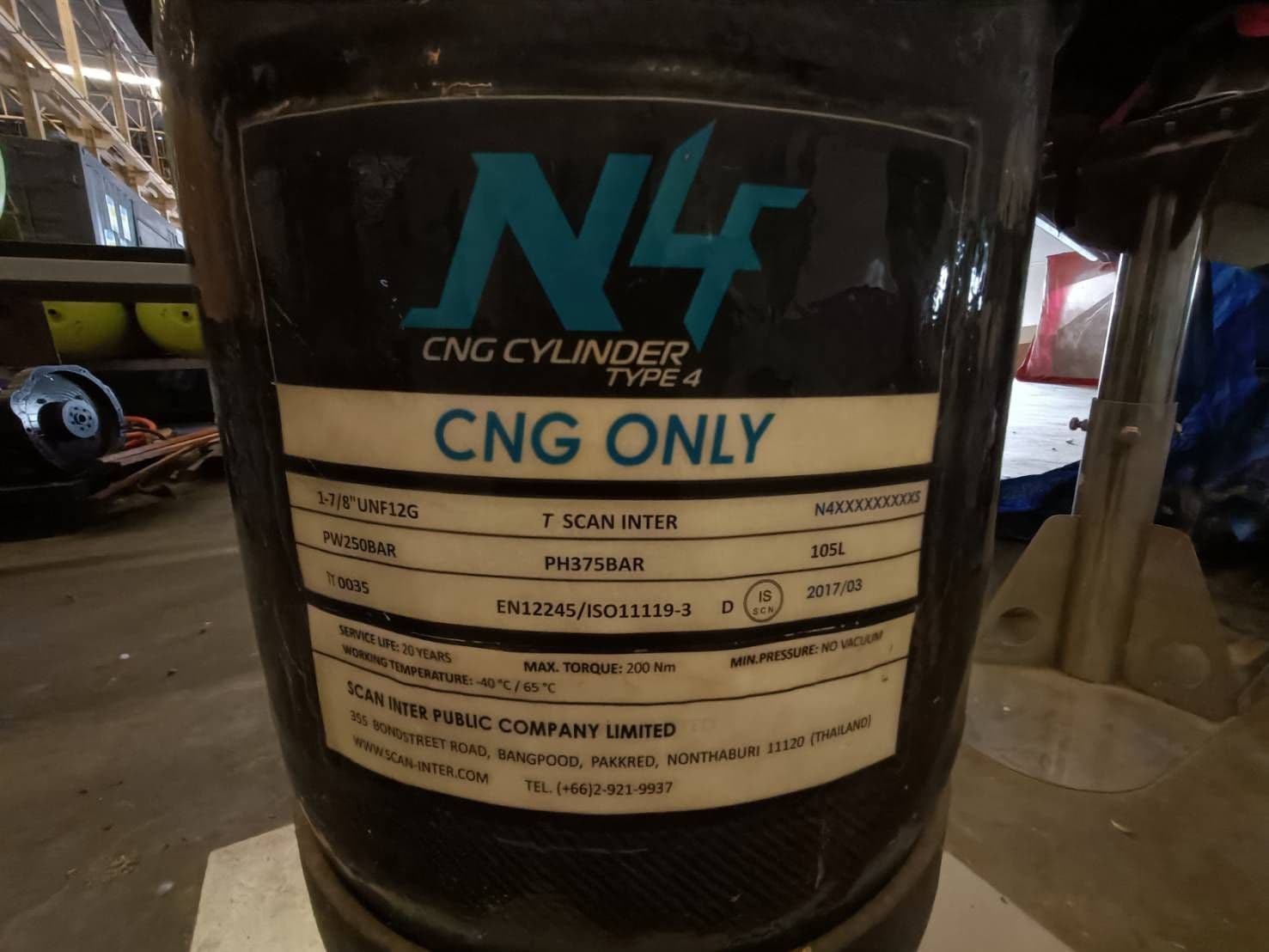
A high-pressure gas storage tank made from composite materials, including carbon fiber, resin, and plastic, is designed for storing compressed natural gas (CNG) or hydrogen. This type of tank is classified as a Type IV high-pressure vessel. In this research, it is designed to operate at a pressure of 250 bar for the transportation of compressed natural gas.
การบรรจุก๊าซที่ความดันสูงต้องใช้บรรจุภัณฑ์ที่มีความแข็งแรง การใช้ถังที่ผลิตจากโลหะถูกนำมาใช้ในช่วงแรกๆ แต่ปัญหาที่ตามมาคือน้ำหนักมากทำให้สิ้นเปลืองเชื้อเพลิงในกรณีที่นำไปติดตั้งบนยานพาหนะ จึงเกิดการพัฒนาถังความดันที่พัฒนาจากวัสดุประกอบขึ้นซึ่งจะช่วยลดน้ำหนักของบรรจุภัณฑ์และการกัดกร่อนเกิดขึ้นน้อย

คณะอุตสาหกรรมอาหาร
Fish gelatin is increasingly recognized as an alternative source of gelatin, but its use has been limited due to weak gelling properties. To address these issues, the effect of furcellaran, a gelling agent, was examined at various levels (25-100% FG substitution) on the structural and physicochemical properties of FG gels. As the amount of FUR increased to 25%, the FG/FUR gel showed improved hardness and gel strength (P<0.05). Additionally, increasing FUR levels led to higher gelling and melting points, showing a dose-dependent relationship. Microstructural analysis revealed that adding FUR created a denser gel network with smaller gaps. SAXS scattering intensities also increased as FUR concentration rose. Overall, adding FUR improved the gelling properties of FG without negatively affecting springiness and syneresis, enhancing gel strength and gelling temperature.
คณะเทคโนโลยีสารสนเทศ
Facial Expression Recognition (FER) has attracted considerable attention in fields such as healthcare, customer service, and behavior analysis. However, challenges remain in developing a robust system capable of adapting to various environments and dynamic situations. In this study, the researchers introduced an Ensemble Learning approach to merge outputs from multiple models trained in specific conditions, allowing the system to retain old information while efficiently learning new data. This technique is advantageous in terms of training time and resource usage, as it reduces the need to retrain a new model entirely when faced with new conditions. Instead, new specialized models can be added to the Ensemble system with minimal resource requirements. The study explores two main approaches to Ensemble Learning: averaging outputs from dedicated models trained under specific scenarios and using Mixture of Experts (MoE), a technique that combines multiple models each specialized in different situations. Experimental results showed that Mixture of Experts (MoE) performs more effectively than the Averaging Ensemble method for emotion classification in all scenarios. The MoE system achieved an average accuracy of 84.41% on the CK+ dataset, 54.20% on Oulu-CASIA, and 61.66% on RAVDESS, surpassing the 71.64%, 44.99%, and 57.60% achieved by Averaging Ensemble in these datasets, respectively. These results demonstrate MoE’s ability to accurately select the model specialized for each specific scenario, enhancing the system’s capacity to handle more complex environments.
คณะเทคโนโลยีสารสนเทศ
The process of treating cancer patients in the chemotherapy department at Chonburi Cancer Hospital is complicated and inconvenient due to the procedure of submitting blood test results through the personal LINE application of medical staff, which hinders workflow efficiency. Therefore, the researcher has developed a cancer patient management and tracking program in the form of a web-based application and LINE LIFF (LINE Front-end Framework) application to facilitate both medical personnel and patients. The web-based application is designed for medical personnel to monitor, schedule, and collect patient data, while the LINE application is designed for patients to submit blood test results, view appointment schedules, record symptoms after chemotherapy, log their weekly weight, and access a chatbot for consultation. This system is developed based on client-server technology, which enhances data analysis efficiency and supports automated treatment planning. As a result, the cancer treatment process becomes faster, more modern, and more efficient.