

The activities of the project's operations consist of: checking microbe on sample food, hygienic condition of cooker, containers and materials, sanitation knowledge and private sanitation and food quality of canteen and cleaning of cooker. The Food Safety Management program collaborated with the Property Management office, planned the operations, and assessed food vendors based on the SAN 20 food safety standards requirements. Using A.13 testing kits, we conducted testing for coliform bacteria contamination in food, containers, equipment, and hand contact surfaces, collecting 6 samples. These included samples such as prepared food, areas in front of the store, and food handlers' hands. Additionally, we used A.11 testing kits to test for coliform bacteria contamination in water and ice. The analysis of results, including physical, microbiological, and chemical aspects, serve as a guideline for improving the quality and safety of food production and service in the institution's canteen.
อาหารเป็นปัจจัยสำคัญที่มีผลต่อการดำเนินชีวิตของประชาชนโดยทั่วไป การบริโภคอาหารที่ไม่สะอาดเป็นสาเหตุสำคัญของการเกิดโรคภัยไข้เจ็บ ซึ่งจากสถานการณ์การเจ็บป่วยของประชาชนที่เกิดจากโรคที่เกิดจากอาหารและน้ำเป็นสื่อในปัจจุบัน มีแนวโน้มเพิ่มขึ้น โดยเฉพาะโรคอุจจาระร่วงเฉียบพลัน ซึ่งเกิดจากการปนเปื้อนของเชื้อโรคในอาหาร โดยปัจจัยที่เกี่ยวข้องอันเป็นสาเหตุที่ทำให้เกิดการปนเปื้อนในอาหาร ได้แก่ ปัจจัยด้านบุคคล เช่น ผู้สัมผัสอาหาร ผู้เตรียมอาหาร ผู้ปรุง ผู้เสิร์ฟ ผู้จำหน่ายอาหาร ที่มีพฤติกรรมที่ไม่ถูกสุขลักษณะ ปัจจัยด้านวัตถุดิบที่เลือกมาปรุง ได้แก่ อาหารสด เนื้อสัตว์ ผักสด อาหารแห้งต้องไม่ปนเปื้อนสารพิษ และต้องสดใหม่ ไม่หมดอายุ หรือเน่าเสีย ปัจจัยด้านสถานที่ได้แก่ บริเวณที่เตรียม ปรุง ประกอบ จำหน่ายอาหารต้องเป็นไปตามหลักสุขาภิบาลอาหาร และสุดท้ายคือปัจจัยด้านภาชนะ อุปกรณ์ที่นำมาใช้สัมผัสอาหาร ได้แก่ จาน ชาม ช้อน ส้อม ตะเกียบ ต้องสะอาดและปลอดภัย และเป็นไปตามเกณฑ์/ตัวชี้วัดของกรมอนามัย ซึ่งโรงอาหารในสถานศึกษา สถาบันเทคโนโลยีพระจอมเกล้าเจ้าคุณทหารลาดกระบัง เป็นสถานที่ที่มีประชาชนเข้ามาใช้บริการเป็นจำนวนมาก โดยมีทั้งนักศึกษา อาจารย์ ผู้ที่ทำงานในหน่วยงาน ตลอดจนเจ้าหน้าที่และประชาชนผู้มาติดต่อ เพราะมีความสะดวก รวดเร็ว ไม่ต้องปรุงประกอบอาหารเอง ซึ่งถ้าหากผู้ประกอบการให้บริการอาหารต่างๆ ขาดความรู้ความเข้าใจในเรื่องการสุขาภิบาลอาหาร ผู้ที่บริโภคก็จะมีโอกาสเสี่ยงต่อการได้รับการรับประทานอาหารที่ไม่สะอาด ปลอดภัย ทางหลักสูตรการจัดการความปลอดภัยอาหารจึงร่วมมือกับสำนักงานบริหารทรัพย์สิน สถาบันเทคโนโลยีพระจอมเกล้าเจ้าคุณทหารลาดกระบัง พัฒนาคุณภาพและความปลอดภัยในการผลิตและบริการอาหารในโรงอาหารด้วยการประเมินสุขาภิบาลอาหารตามหลัก SAN พร้อมทั้งอบรมให้ความรู้กับผู้ประกอบกิจการและผู้สัมผัสอาหารให้มีความตระหนักเข้าใจในการจัดการโรงอาหารที่มีคุณภาพ สะอาด และปลอดภัยสำหรับผู้บริโภค
คณะวิทยาศาสตร์
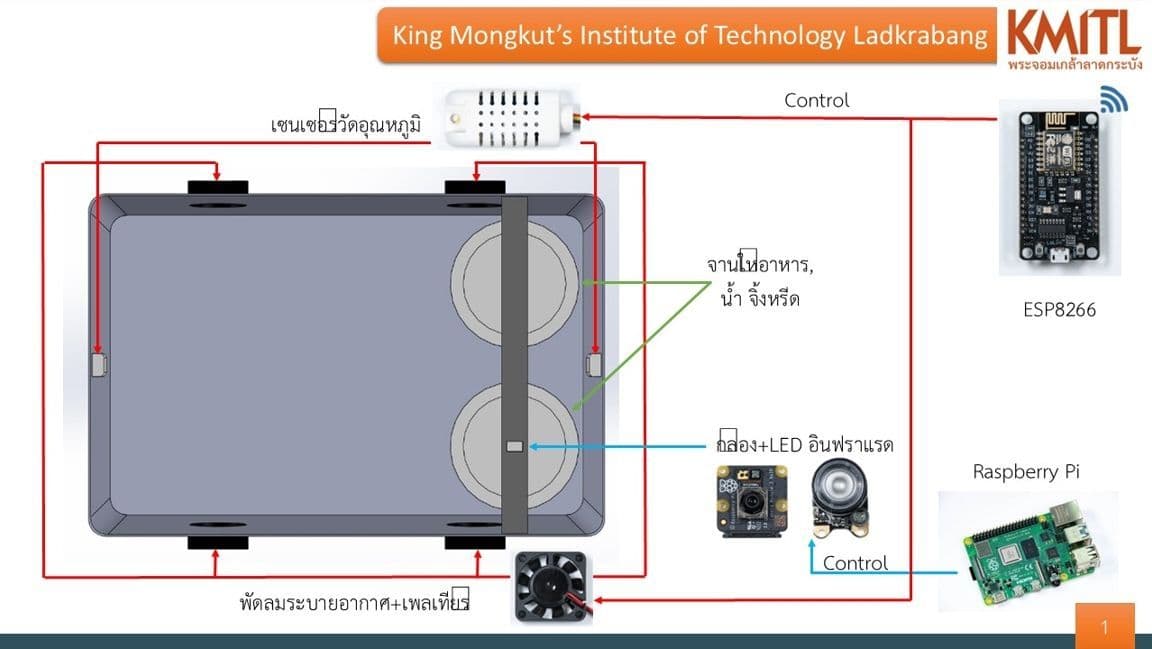
In raising crickets for meat consumption, the growth rate and growth period of crickets are important data used to identify the number of crickets per breeding area at each age. Therefore, the researcher has an idea to create a system for monitoring the growth rate of crickets in a closed system using an infrared camera combined with computer image processing to study the growth and identify the growth period of crickets at each age in order to obtain knowledge that can be disseminated to farmers to improve the breeding process for maximum efficiency.
คณะวิศวกรรมศาสตร์
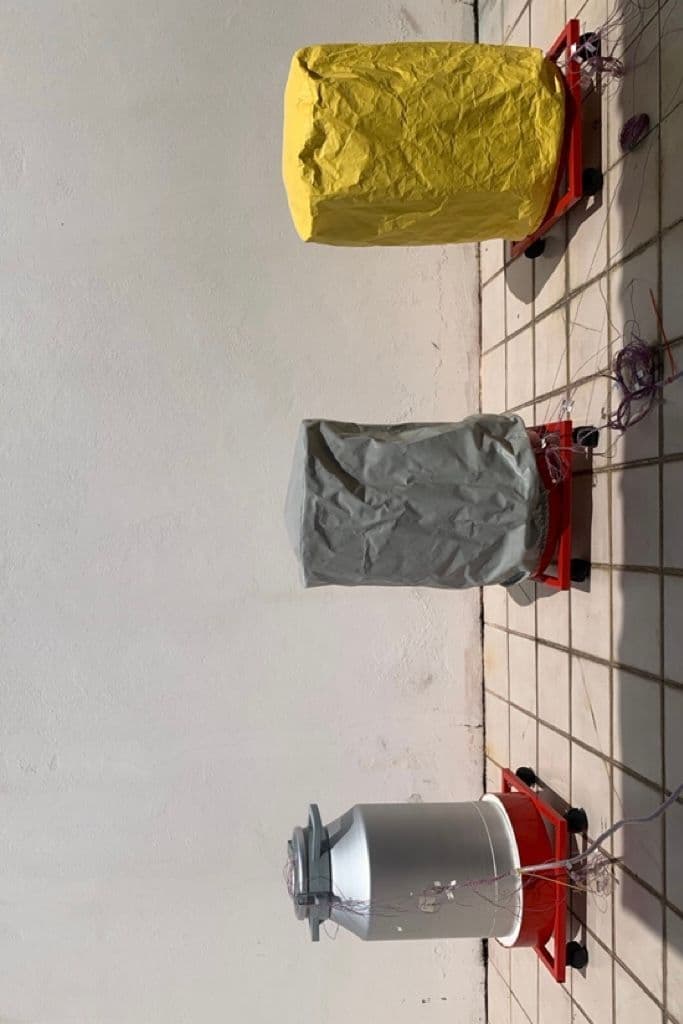
This study was conducted to develop a prototype cooling cover for transporting raw milk, aiming to provide a solution for maintaining the quality of raw milk during transportation to milk collection centers. The cooling cover is made using Phase Change Material (PCM), produced from water mixed with a gelling agent, in an amount of 5.6 kg, attached around an aluminum milk tank (with a capacity of 25 L). The cover is then covered with a UV-reflective fabric in two types: polyvinyl chloride (PVC) and high-density polyethylene (HDPE). The temperature reduction performance of both types of covers was evaluated by measuring water temperatures at various points along the radial and vertical directions of the milk tank at six points, using type-T thermocouples, under three environmental conditions: a constant temperature of 25 °C, 35 °C, and outdoor ambient temperature (average temperature 35.5 °C) for a minimum duration of 180 min. The experimental results revealed that at 120 min., the water in the tank covered with PCM-PVC and PCM-HDPE covers had temperatures lower than the ambient temperature by 12.6 °C and 12.9 °C, respectively, under a constant ambient temperature of 25 °C, and under a constant ambient temperature of 35 °C lower by 16.7 °C and 16.4 °C, respectively, and outdoor conditions. Since the temperature reduction performance of PCM-PVC and PCM-HDPE covers showed no significant difference, the performance of microbial quality preservation of raw milk was assessed only with PCM-PVC cover in comparison to a non-covered case (control), by measuring coliform and Escherichia coli counts using compact dry plates. Results indicated that after 120 min., milk in the tank covered with PCM-PVC had an average coliform count of 1.6 × 10^4 CFU/ml and E. coli count of 2 × 10^3 CFU/ml, which was lower than the non-covered control with an average coliform count of 1.5 × 10^4 CFU/ml and E. coli count of 1.1 × 10^4 CFU/ml. This study concludes that the temperature reduction achieved by the cooling cover can help inhibit coliform growth to levels below raw milk quality standards, demonstrating the potential of the cooling cover in maintaining the quality and safety of raw milk during transport, ultimately contributing to an improved quality of life for Thai dairy farmers.

คณะวิทยาศาสตร์
A new colorimetric assay for the rapid detection of tannic acid in beverage samples based on displacement phenomenon of aggregated gallic acid-modified platinum nanoparticles is developed for the first time. PtNPs were functionalized with gallic acid, promoting the formation of the green-hued aggregated nanoparticles. While colorimetry offers a rapid method for identifying tannic acid, challenges remain in sensitivity and accuracy of detection on the PtNPs colorimetric probe, particularly in the presence of anthocyanin interferences. To address this, we developed a sample preparation method to degrade anthocyanin in beverages. Tannic acid was easily displaced onto the gallic acid-coated PtNPs surfaces, causing dispersion and resulting in a visible color change from green to orange−brown. Under the optimal conditions, the colorimetric sensor exhibited a linear response in the range of 1−2,000 µmol L−1 (R2 = 0.9991). The limit of detection (LOD) and the limit of quantification (LOQ) were found at 0.02 and 0.09 µmol L−1, respectively. The proposed sensor expressed superior selectivity over other interfering substances and demonstrated excellent precision with a relative standard deviation (RSD) of 1.00%−3.36%. More importantly, recoveries ranging from 95.0−104.7% were obtained, indicating the capability of proposed colorimetric sensor to detect tannic acid rapidly and accurately in real beverage samples.